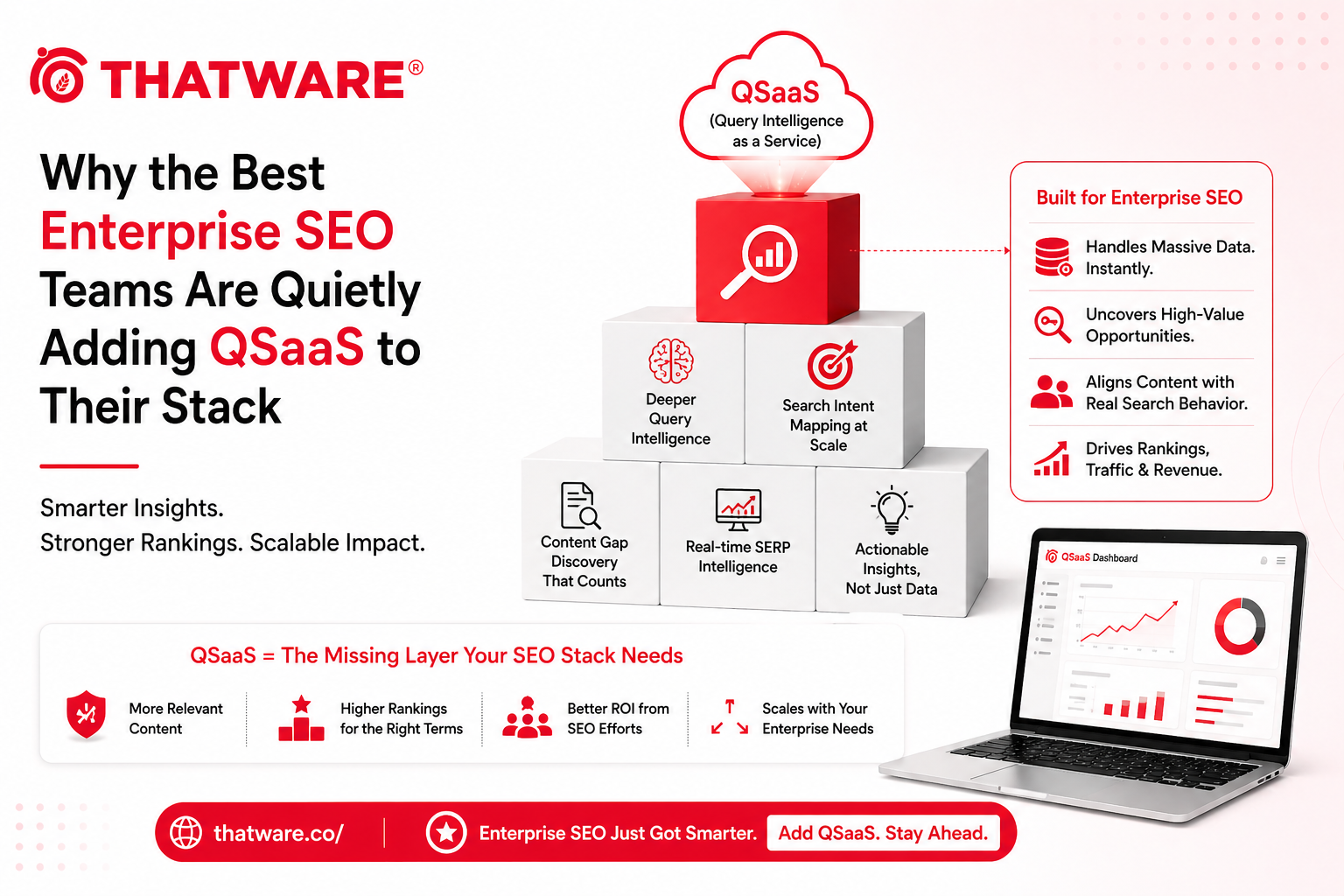
Enterprise SEO teams are not typically early adopters of new frameworks. The organizational dynamics that make large companies slow at implementing SEO recommendations – approval processes, stakeholder alignment requirements, risk-aversion around changes to high-traffic properties – also make them slow at adopting new strategic approaches. When something is working, there’s institutional inertia around changing it.
Which makes the quiet but consistent pattern of enterprise SEO teams adding Quantum SEO as a Service (QSaaS) to their stack interesting. These aren’t early-adopter startups. These are teams with sophisticated existing capabilities – multiple dedicated SEOs, premium tooling, established measurement infrastructure – choosing to layer something new on top of what they’re already doing well. The question is why.
What Enterprise Teams Have That Makes QSaaS Different for Them
Before getting into why enterprise teams are adopting QSaaS, it’s worth noting what makes their context specifically different from smaller organizations.
Enterprise SEO teams typically have good coverage of the standard disciplines. Technical SEO – solid. Content program – established. Link building – active. Measurement – reasonably sophisticated. They’re not adding QSaaS because they’re missing the basics. They’re adding it because they’ve hit a ceiling on what standard-discipline execution is producing in competitive categories.
In highly competitive categories, when everyone has good technical SEO and a reasonable content program, the marginal return on improving those individual dimensions is relatively small. What changes performance at the margin in mature competitive landscapes is how the dimensions interact – finding the signal combinations, the compound investment strategies, and the opportunity patterns that aren’t visible when you look at each dimension separately.
Qsaas services are designed for exactly this context. They’re most valuable when the individual dimension performance is already reasonable and the ceiling is in the interactions.
The Multi-Variable Analysis That Standard Audits Don’t Provide
Here’s a specific example of the kind of insight QSaaS analytical approaches surface that standard SEO analysis doesn’t.
Standard competitive analysis: Site A outranks Site B for [category keywords]. Site A has higher domain authority, more content coverage, and stronger backlink profile. Recommendations: build more links, expand content, improve authority.
QSaaS-informed analysis: Site A outranks Site B, but the authority advantage is concentrated specifically in industry trade publication links combined with high E-E-A-T author signals on content – not general domain authority. The specific combination of editorial trade links + attributed expert content is what’s driving the ranking differential. Sites C, D, and E in the same category have higher domain authority than Site A but rank below it, because they lack this specific combination. The actionable insight isn’t “build more links” – it’s “build links from trade publications specifically, while implementing attributed expert content” as a coordinated initiative.
That specificity – identifying which combination of signals is driving the outcome, rather than which individual signals are present – is what the quantum/multi-variable approach adds. It’s a different quality of insight from standard competitive benchmarking.
Where Enterprise Teams Are Deploying QSaaS Specifically
From the pattern of enterprise adoption, QSaaS is being applied to specific problems rather than replacing the full SEO stack.
Competitive category analysis for strategic planning. Large companies need to make multi-year investment decisions about which categories to pursue, how aggressively to compete, and what the realistic ceiling for organic performance in a category is. Multi-variable competitive analysis that understands signal interactions gives strategic planning teams a more accurate model than single-dimension benchmarking provides.
Recovery diagnosis after algorithm impact. When a core update moves rankings significantly, identifying the actual cause – not the assumed cause – requires understanding which signal combinations changed and why. Standard audits often produce technically correct but insufficiently specific explanations. Multi-variable analysis surfaces the specific signal patterns that explain the observed changes.
International market evaluation. Deciding whether to invest in SEO for a new international market, and what the realistic competitive landscape looks like, benefits from analysis that models how the signal combinations differ between markets – not just whether keyword volumes are sufficient.
The Integration with Existing Enterprise Tooling
A practical consideration for enterprise teams evaluating QSaaS: how does it integrate with existing tooling and processes?
Quantum seo services at the enterprise level typically sit above the standard tooling layer rather than replacing it. The standard tools – Ahrefs, Semrush, Search Console, enterprise crawlers – provide the data inputs. The QSaaS layer is the analytical framework that processes those inputs differently, looking for multi-dimensional patterns rather than single-dimension benchmarks.
Integration with existing reporting is an important consideration. Enterprise teams have established reporting frameworks and stakeholder expectations. QSaaS insights need to be communicable within those frameworks to be actionable – which means the providers need to be able to translate multi-variable analysis findings into the business language and reporting structures that enterprise stakeholders are already using.
The best enterprise QSaaS deployments treat the QSaaS layer as an analytical engine that feeds into existing decision-making and reporting processes, not as a separate strategic track that runs parallel to the existing program. Integration produces better organizational traction than separation.
Measuring Whether It’s Working
How do enterprise teams evaluate whether their QSaaS investment is producing value? The measurement challenge is real because QSaaS is an analytical and strategic layer, not a direct deliverable – it influences which tactics are prioritized and how they’re coordinated, rather than directly producing rankings or traffic.
The most pragmatic measurement approach: compare the outcomes of strategic initiatives guided by QSaaS analysis against comparable initiatives guided by standard analysis, in similar competitive contexts. If the QSaaS-informed initiatives consistently produce higher-impact outcomes – either larger ranking improvements, faster results, or better durability through algorithm changes – the analytical layer is adding value.
This comparison is imperfect because competitive contexts are never perfectly equivalent and confounding variables are numerous. But the directional signal is useful. Enterprise teams that maintain the measurement discipline to compare strategy quality over time generally find the analytical layer justifies the investment. The ones that don’t measure at this level of strategic quality can’t tell – which is a different problem worth solving regardless of whether QSaaS is in the stack.